www.aljazeerah.info
2026 News
Archives
Mission & Name
Conflict Terminology
Editorials
Gaza Holocaust
Gulf War
Isdood
Islam
News
News Photos
Opinion Editorials
US Foreign Policy (Dr. El-Najjar's Articles)
www.aljazeerah.info
|
Editorial Note: The following news reports are summaries from original sources. They may also include corrections of Arabic names and political terminology. Comments are in parentheses. |
***
US-Iran MoU Includes Ending Hostilities Across All Fronts, Releasing $12 Billion in Frozen Assets, Lifting the Maritime Blockade, Reopening the Strait of Hormuz, Delaying the Nuclear File to a Later Stage
May 27, 2026
***
 |
|
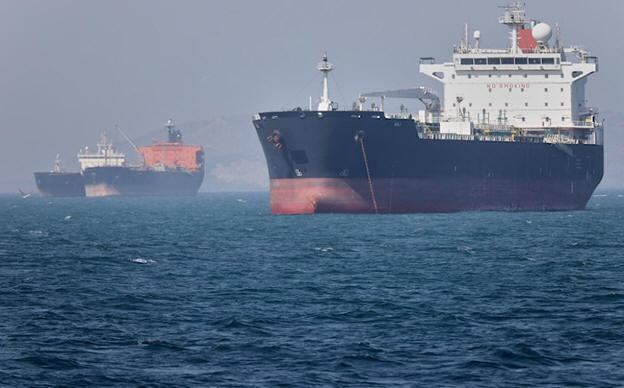
| US-Iran MoU Includes Ending hostilities across all fronts, Releasing $12 billion in frozen assets, Lifting the maritime blockade, Reopening the Strait of Hormuz, May 27, 2026 (Above: Oil Tankers anchoring in the Iranian port of Bandar Abbas, on May 2, 2026). |
***
***
Initial steps of US-Iran MoU, subsequent phases revealed: Tasnim
Al-Mayadeen, May 27, 2026
Negotiations between Tehran and Washington are reportedly moving forward on a draft framework involving frozen Iranian assets, maritime arrangements, and a structured timeline for further talks.
Progress has been made regarding the release of $12 billion in frozen Iranian assets following the visit of an Iranian delegation to Qatar, the Iranian news agency Tasnim reported, citing sources, noting that certain details related to the unfreezing of funds have not yet been definitively finalized.
Reaching a final formulation of the memorandum of understanding between Washington and Tehran requires resolving outstanding differences, as per the same sources.
They emphasized that the mechanism for announcing the memorandum must be joint, warning that any unilateral announcement by the United States could be “not entirely accurate.”
Initial steps toward an understanding, subsequent phases
The initial framework of the proposed understanding includes:
1. Ending hostilities across all fronts;
2. Releasing $12 billion in frozen assets;
3. Lifting the maritime blockade;
4. Reopening the Strait of Hormuz.
The sources further indicated that, following the implementation of this initial phase, a 60-day negotiation period, extendable, would be allocated to address Iran’s nuclear file.
They added that Tehran has not, in this initial phase, made any commitments regarding enriched materials or the suspension of enrichment activities. They also stressed the need to suspend sanctions that obstruct the sale of Iranian oil, petrochemicals, and related derivatives throughout the negotiation period.
The reopening of the Strait of Hormuz and the lifting of the maritime blockade are expected to be completed within 30 days, as per Tasnim.
Iranian negotiator to Fars: Trump may unilaterally announce agreement
A member of Iran’s negotiating team said that US President Donald Trump may, in the coming hours, unilaterally announce the completion of an agreement between Iran and the United States, the Fars News Agency reported.
The negotiator said such a move is viewed as an attempt to exert pressure on Iran and create the impression of a finalized settlement in the public sphere, prior to the resolution of all outstanding disputes.
He added that several files and issues remain unresolved, stressing that no agreement will be concluded unless all matters of concern to Iran are fully addressed.
The negotiator further stated that Iran will officially announce the outcome once all issues have been fully settled.
Iran TV shows details of unofficial preliminary US-Iran MoU framework
Earlier, the Iranian state television unveiled a preliminary and unofficial draft memorandum of understanding between Iran and the United States, outlining potential arrangements on maritime activity and regional security.
The draft framework, as per the broadcaster, suggests that the United States would commit to lifting a maritime blockade on Iran. In return, Iran would agree to restore commercial shipping through key maritime routes to pre-escalation levels within one month.
The reported arrangement does not apply to military vessels.
The report also said the draft includes provisions placing the management and regulation of maritime transit routes under Iranian oversight, in coordination with the Sultanate of Oman.
These developments come amid rising expectations of a possible framework agreement between Tehran and Washington aimed at ending the war, with continued Pakistani diplomatic efforts and Qatar’s growing role in mediation.
The talks have reportedly encountered obstacles over two issues Tehran considers fundamental: the cessation of hostilities in Lebanon and the mechanism for releasing frozen Iranian assets, while the nuclear file is expected to be addressed in later stages.
Initial steps of US-Iran MoU, subsequent phases revealed: Tasnim | Al Mayadeen English
***
Trump says he won’t rush Iran deal, threatens to 'blow up' Oman
ByAl Mayadeen, May 27, 2026
The US president signals he is willing to prolong negotiations with Tehran, insisting he will not be constrained by political deadlines even as midterms loom.
US President Donald Trump claimed the Strait of Hormuz would remain accessible to all nations and insisted Washington would oversee security in the strategic waterway as part of ongoing negotiations with Iran.
Speaking during a Cabinet meeting, Trump rejected any proposal that would allow Iran or Oman to manage the passage independently.
“It’s international waters. Nobody’s going to control it. We’re going to watch over it. We’ll watch over it, but nobody’s going to control it,” Trump alleged. “That’s part of the negotiation that we have.”
Trump also directly threatened Oman, saying the country should not obstruct US objectives in the region.
“Oman will behave just like everybody else, or we’ll have to blow ‘em up,” the president stressed.
When asked whether he would consider a temporary arrangement giving Iran and Oman authority over the crucial shipping lane, Trump replied, “No, the strait’s going to be open to everybody.”
It is worth noting that Iranian officials have repeatedly assured that oversight of the strait is a regional matter unrelated to the United States. Iranian Foreign Ministry spokesperson Esmaeil Baghaei said earlier this week that coordination over the waterway would involve Oman rather than Washington.
Trump links Iran deal to 'Abraham Accords' expansion
Trump also indicated he may delay or reject a potential agreement with Iran unless additional Middle Eastern countries agree to join the US-backed normalization framework with "Israel" established during his first administration.
“That really would be a tremendous sign, and I think those countries owe it to us,” Trump said. “I’m not sure we should make the deal if they don’t sign, you want to know the truth.”
The president has recently urged countries, including Saudi Arabia, Qatar, and Pakistan, to join the deals, though there has been little public indication that those governments are prepared to do so.
While Trump later softened his remarks by declining to make participation in the normalization ties an explicit condition for a deal, he stressed that Washington would only proceed if the final terms met US expectations.
“We can make a good deal right now, but maybe not a great deal,” he said. “And if it’s not a great deal, we’re not making it.”
No sanctions relief or uranium transfer
The US president also adopted a tougher position on Iran’s enriched uranium stockpile, saying he would oppose any arrangement allowing Russia or China to take possession of the material.
“No I wouldn’t be comfortable,” he said when asked about the possibility of Moscow or Beijing receiving Iran’s near-weapons-grade uranium reserves, which are believed to be stored in fortified underground facilities.
Earlier in the week, Trump suggested the uranium could be “destroyed in place or, at another acceptable location,” though he did not specify where.
The president also ruled out sanctions relief in exchange for Tehran surrendering its uranium stockpile.
“We’re not talking about any easing of sanctions or giving money. No sanctions, no money, no nothing,” Trump said. “We have control of money that they claim is theirs. We’ll keep control of that money, when they behave properly and when they do what’s right, we’ll let them have their money, but right now we’re not doing that.”
In a separate interview with PBS News, Trump reiterated that Iran would not receive economic concessions in return for handing over highly enriched uranium.
“They’re gonna give up their highly enriched uranium not for sanctions relief. No, no, not at all,” he said.
Trump says political pressure won’t affect Iran policy
During the Cabinet meeting, Trump dismissed suggestions that domestic political concerns or upcoming midterm elections would influence his approach toward Iran.
“They thought they were going to outwait me, you know? We’ll outwait him, he’s got the midterms,” Trump stressed.
“I don’t care about the midterms. Look what happened last night, that was a prelude to the midterms. People understand it,” he added, referring to the victory of his endorsed candidate in a Republican Senate primary runoff in Texas.
Trump expressed confidence that negotiations would eventually produce an agreement, but warned that military action remained possible if talks failed.
“We’re not satisfied with it, but we will be,” he said. “Either that, or we’ll have to just finish the job.”
Earlier, White House spokesperson Olivia Wales told Al Mayadeen that "as President Trump has said, negotiations are proceeding nicely, and he has made his redlines clear," adding that he "will only make a good deal for the American people, which must ensure that Iran can never have a nuclear weapon."
Trump jokes that Hegseth 'loves war'
While introducing Cabinet members at the White House meeting, Trump joked that War Secretary Pete Hegseth was eager for wars.
“We have great people, and the secretary of war, Pete Hegseth — central casting — he loves war … he’s a good man,” Trump stated.
Hegseth has faced growing criticism since the outbreak of the US-Israeli aggression on Iran, with opponents accusing him of favoring an aggressive military posture and confrontational public messaging.
The Cabinet meeting marked the 12th of Trump’s second term and took place amid intensifying negotiations with Iran and mounting scrutiny over Washington’s next steps in the aggression.
Trump says he won’t rush Iran deal, threatens to 'blow up' Oman | Al Mayadeen English
***
IRGC targets US military base in response to attack on Bandar Abbas
Al Mayadeen, May 28, 2026
The Islamic Revolution Guard Corps announced targeting a US military base in the region in response to a US attack on Bandar Abbas originating from it.
Iran's Islamic Revolution Guard Corps (IRGC) issued a stern warning on Thursday following a US military violation and aggression near the Bandar Abbas Airport, stressing that any further aggression “will not go unanswered.”
In a statement released by its public relations office, the IRGC said the US military launched aerial projectiles at a location on the outskirts of Bandar Abbas before dawn. It added that Iran responded by targeting the US air base from which the attack originated at approximately 4:50 am.
The operation comes as a “serious warning,” the IRGC said, adding that the response was intended to demonstrate that any aggression against Iran would be met with retaliation, warning that any repeat attack would provoke “a more decisive response.”
“The responsibility for the consequences lies with the aggressor,” the statement added.
At the same time, the Kuwaiti military confirmed that “air defense systems are confronting missile and drone attacks.”
During the war, Iran repeatedly warned that any US military base used to launch attacks against its territory would be considered a legitimate target, stressing that while it maintains friendly relations with neighboring countries, it would not hesitate to strike the source of any aggression.
US attacks Bandar Abbas
This comes after the US military targeted the “scorched earth” areas surrounding the city of Bandar Abbas, as explosions were heard across the area without any reported casualties or material damage, according to an Iranian military source cited by Tasnim News Agency.
Shortly after, Iranian media outlets reported hearing three explosions east of Bandar Abbas, with air defense systems activated.
Meanwhile, Reuters quoted a US official as saying that the US military had carried out fresh strikes on an Iranian military site near the Strait of Hormuz and allegedly intercepted several Iranian drones that were deemed "a threat to US forces."
Similarly, on Monday, the US launched an aggression on alleged missile sites in southern Iran and targeted boats allegedly attempting to lay naval mines in the area, according to the US Central Command.
US tanker forced to retreat from Hormuz following Iranian intervention
In a related escalation, a US oil tanker attempted to cross the Strait of Hormuz overnight after disabling its radar system, but was forced to retreat after the Iranian navy responded swiftly and opened fire on the vessel, Tasnim reported, citing an Iranian military source.
Washington's continued violations have raised fresh concerns over the stability of the current ceasefire and prospects for a broader regional agreement, with the US yet again bombing Iran in the middle of talks.
Just yesterday, Tasnim reported that progress has been made in talks, particularly on the release of Iran's frozen assets in Qatar. However, reaching a final formulation of the memorandum of understanding between Washington and Tehran requires resolving outstanding differences, as per the same sources.
They emphasized that the mechanism for announcing the memorandum must be joint, warning that any unilateral announcement by the United States could be “not entirely accurate.”
The initial framework of the proposed understanding includes ending the aggression on all fronts, releasing Iran's frozen assets, lifting the maritime blockade, and reopening the Strait of Hormuz.
The sources further indicated that, following the implementation of this initial phase, a 60-day negotiation period, extendable, would be allocated to address Iran’s nuclear file.
IRGC targets US military base in response to attack on Bandar Abbas | Al Mayadeen English
***
War on Iran accelerates global energy realignment, IEA warns
Al-Mayadeen, May 28, 2026
The International Energy Agency says global energy investment is undergoing a structural shift as the war on Iran intensifies geopolitical fragmentation and drives states toward energy sovereignty and supply diversification.
The International Energy Agency (IEA) says global energy investment is entering a new phase of restructuring, as the ongoing US-Israeli war on Iran accelerates instability across key supply routes and deepens fragmentation in the international energy order.
While presented through technical forecasts, the agency’s latest World Energy Investment report reflects a broader reality: energy markets are increasingly shaped not by demand alone, but by geopolitical confrontation, sanctions regimes, and the breakdown of predictable trade flows.
IEA Executive Director Fatih Birol described the situation as an unprecedented energy security crisis, comparable to the systemic shocks of the 1970s.
“We are in the midst of the largest energy security crisis the world has ever faced,” Birol said, acknowledging the scale of disruption now influencing global investment behaviour.
Energy sovereignty replaces market-driven logic
The report indicates that states are increasingly shifting away from reliance on vulnerable maritime corridors and externally controlled supply chains, many of which have been destabilized or re-evaluated amid the war on Iran.
This shift is not purely technical. It reflects a broader geopolitical response in which states, particularly in the Global South and major import-dependent economies, are prioritizing energy sovereignty and strategic autonomy over cost efficiency.
Investment is increasingly directed toward domestic resources, alternative corridors, and infrastructure designed to reduce exposure to chokepoints historically shaped by Western naval dominance and geopolitical pressure.
Read more: Iran war forces Gulf states to rethink regional strategy
Global investment reaches $3.4 trillion amid fragmentation
According to the IEA, global energy investment is projected to reach $3.4 trillion in 2026, underscoring continued capital expansion despite deepening uncertainty.
Around $2.2 trillion will go into electricity systems, renewable energy, nuclear power, energy efficiency, electrification, and storage infrastructure.
The remaining $1.2 trillion is expected to flow into fossil fuels, including oil, gas, and coal, highlighting the uneven and fragmented nature of the global energy transition.
Rather than a unified shift, the data points to parallel energy strategies emerging across competing economic blocs.
Renewables expand alongside infrastructure militarization of energy systems
Renewable energy investment is projected at $665 billion in 2026, with solar accounting for $365 billion.
Grid expansion is expected to reach $550 billion, reflecting the growing strategic importance of electricity transmission systems as states seek to secure internal stability amid external volatility.
Battery storage investment is set to surpass $100 billion, reinforcing efforts to stabilize grids increasingly exposed to fluctuating supply conditions and geopolitical shocks.
Oil declines while gas and coal reflect security-driven divergence
Despite high prices, oil investment is forecast to fall for a third consecutive year, dropping below $500 billion in 2026.
The IEA attributes this to long-term uncertainty, supply constraints, and the absence of stable geopolitical conditions required for large-scale upstream investment.
By contrast, natural gas investment is projected to rise to $330 billion, driven by liquefied natural gas expansion projects concentrated in the United States and Qatar.
Coal investment is also set to reach $180 billion, the highest level in a decade, with China accounting for the majority of global spending as several Asian states extend coal operations under energy security imperatives.
War on Iran accelerates global energy realignment, IEA warns | Al Mayadeen English
Fair Use Notice
This site contains copyrighted material the
use of which has not always been specifically authorized by the copyright
owner. We are making such material available in our efforts to advance
understanding of environmental, political, human rights, economic,
democracy, scientific, and social justice issues, etc. We believe this
constitutes a 'fair use' of any such copyrighted material as provided for
in section 107 of the US Copyright Law. In accordance with Title 17 U.S.C.
Section 107, the material on this site is
distributed without profit to those
who have expressed a prior interest in receiving the included information
for research and educational purposes. For more information go to: http://www.law.cornell.edu/uscode/17/107.shtml.
If you wish to use copyrighted material from this site for purposes of
your own that go beyond 'fair use', you must obtain permission from the
copyright owner./font>
|
||||||||||||||||