www.aljazeerah.info
2026 News
Archives
Mission & Name
Conflict Terminology
Editorials
Gaza Holocaust
Gulf War
Isdood
Islam
News
News Photos
Opinion Editorials
US Foreign Policy (Dr. El-Najjar's Articles)
www.aljazeerah.info
|
Editorial Note: The following news reports are summaries from original sources. They may also include corrections of Arabic names and political terminology. Comments are in parentheses. |
***
In Response to Trump's Threats, Spanish Prime Minister, Pedro Sanchez, Stood by his Anti-War Position, Against the War on Iran, Ukraine, and Gaza
March 5, 2026
***
 |
|
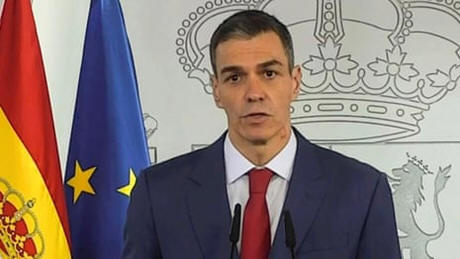
| Spanish Prime Minister, Pedro Sanchez, delivered an address on Wednesday after US President, Donald Trump, threatened to cut off trade to the country, March 4, 2026. | |
| https://x.com/i/status/2029117754217783578 |
***
Spain responds after Trump threatens to cut off trade to the country
Story by Rey Harris
TAG24 NEWS, March 5, 2026
Madrid, Spain -
Pedro Sánchez, the prime minister of Spain, recently responded after President Donald Trump threatened to end trade with his country over its opposition to the US-Israeli war on Iran.
In a televised address on Wednesday, Sánchez stood by his anti-war stance, which his country has maintained throughout both the Ukraine and Gaza conflicts.
"The question is not if we are on the side of the ayatollahs – nobody is. The question is whether we are in favor of peace and international legality," Sánchez said.
99 Tips From Successful Retirees
Fisher Investments·SponsoredHe went on to point out how incredibly unpopular it was when former Prime Minister Jose Maria Aznar dragged Spain into the Iraq war in the early 2000s.
"No to the collapse of an international law that protects us all, especially civilians," Sánchez said.
"No to assuming that the world can only solve its problems through bombs. Let us not repeat the mistakes of the past. No to war."
The address came after Trump held a meeting with German Chancellor Friedrich Merz on Tuesday, during which he criticized Spain for refusing to allow the US use their bases to target Tehran and revealed he was seeking to "cut off all dealings with Spain."
While Sánchez didn't mention the threat directly during his address, he did vow to "protect" Spaniards from the expected economic problems the war on Iran may bring, such as a spike in oil prices.
"We are studying ways to mitigate the economic impact," Sánchez said. "We have the capacity and the political will – we did it during the pandemic."
Related video: President Trump blasts Spain for not helping with Iran attacks (WTOL Toledo)
Here are the Spanish text of the Sanchez statement on X:
La posición del Gobierno de España ante esta coyuntura es clara y consistente. La misma que hemos mantenido en Ucrania y Gaza.
No a la quiebra de un derecho internacional que nos protege a todos, especialmente a la población civil.
No a asumir que el mundo solo puede resolver sus problemas a base de bombas.
No repitamos los errores del pasado.
NO A LA GUERRA.
Google English translation of the statement:
The Spanish government's position on this situation is clear and consistent.
It is the same position we have maintained in Ukraine and Gaza.
No to the breakdown of international law that protects us all, especially the civilian population.
No to assuming that the world can only solve its problems with bombs.
Let's not repeat the mistakes of the past.
NO TO WAR.
***
‘No to War’: Spain Rebukes Trump’s Trade Threats, Refuses to Aid Iran Conflict
Time, Mar 4, 2026
Spanish Prime Minister Pedro Sánchez doubled down on his refusal to become involved in the Iran conflict and rebuked U.S. President Donald Trump’s threat to cut off trade with Spain as a form of punishment.
“The position of the Government of Spain can be summed up in three words,” said Sánchez in a televised address Wednesday morning. “No to war.”
Sánchez argued Europe has been in a similar situation before, referring to the negative impact of the Iraq war. “We must not repeat the mistakes of the past,” he urged.
“Twenty-three years ago, another U.S. Administration dragged us into a war in the Middle East,” he said. “A war which, in theory, was said at the time to be waged to eliminate Saddam Hussein’s weapons of mass destruction, to bring democracy, and to guarantee global security but.. it unleashed the greatest wave of insecurity that our continent had suffered since the fall of the Berlin Wall.”
In a message shared after his address, Sánchez reiterated his stance, saying “no to violations of international law” and “no to the illusion that we can solve the world’s problems with bombs.”
Sánchez—a long-time critic of Israel’s actions in Gaza, and the European response—received swift support from his colleagues. Budget Minister María Jesús Montero echoed his remarks, insisting that Spain “will not be vassals” to another country.
The strong response from the European nation comes after Trump posed economic threats during a press briefing at the White House Tuesday alongside visiting German Chancellor Friedrich Merz.
Reflecting on the U.S.-Israeli military action against Iran, which killed the country’s Supreme Leader Ali Khamenei, Trump heralded the success of the operation and vowed to keep moving forward. But he hit out at some European allies, including Spain, for denying the U.S. access to their military bases.
Friedrich Merz, Germany's Chancellor, and U.S. President Donald Trump during a meeting in the Oval Office of the White House in Washington, D.C., on March 3, 2026. Samuel Corum—Getty Images
“Spain has been terrible. I told Scott [Bessent, Treasury Secretary] to cut off all dealings with Spain,” he said, threatening to impose an economic punishment. “We’re going to cut off all trade with Spain. We don’t want anything to do with Spain.”
“Spain said we can’t use their bases. We could use their bases if we wanted to, we could just fly in and use it, nobody is going to tell us not to use it, but we don’t have to,” Trump argued. “Spain has absolutely nothing we need, other than great people, but they don’t have great leadership.”
He also faulted Spain for failing to commit to increasing defense spending to 5% of GDP under NATO targets.
Trump’s criticism extended to other nations, as he accused the United Kingdom of being “uncooperative.”
“We are very surprised. This is not Winston Churchill that we're dealing with,” he said, referencing U.K. Prime Minister Keir Starmer.
While Starmer initially refused to allow Trump to use British bases to launch defensive missiles, he reversed course on Sunday evening, announcing Britain will grant access to the U.S. military.
Europe rallies behind Spain
European leaders have shown support to Spain following Trump’s trade threats, framing the dispute as a test of E.U. unity.
According to local media, French President Emmanuel Macron reached out to Sánchez on Wednesday to express “solidarity.”
Officials in Brussels, meanwhile, reiterated that trade policy rests with the bloc—not individual member states.
“The E.U. will always ensure that the interests of its member states are fully protected,” said European Council President António Costa. “We reaffirm our firm commitment to the principles of international law and the rules-based order everywhere in the world.”
Olof Gill, spokesperson for Trade and Economic Security at the European Commission, told TIME: “The Commission will ensure that the interests of the European Union are fully protected. We stand in full solidarity with all member states and all its citizens and, through our common trade policy, stand ready to act if necessary to safeguard E.U. interests.”
He urged the U.S. to ”fully honor the commitments undertaken” in the E.U.-U.S. trade agreement that was struck last year.
Teresa Ribera, an executive vice-president of the European Commission who previously served as the Deputy Prime Minister of Spain, described Trump’s comments as destabilizing.
“I think that the instability, the tension generated by this way of relating to, or speaking about third parties—whether it’s about Starmer, Macron, or Sánchez—is deeply disruptive, not only for societies, for peace, for cooperation, but also for the economy,” she said in an interview with a Spanish radio network. “It has immediate consequences for the overall economic activity of everyone.”
European Commission vice president Stéphane Séjourné echoed that message, warning that economic pressure on one member state amounts to pressure on all.
Spain Rebukes Trump's Threats, Refuses to Aid Iran Conflict | TIME
***
‘No to war’: Sánchez doubles down after Trump threat to cut off trade with Spain
PM says his country will not be complicit in growing conflict in Middle East ‘simply out of fear of reprisals from someone’
Sam Jones in Madrid
The Guardian, Wed 4 Mar 2026
The Spanish prime minister, Pedro Sánchez, has responded to Donald Trump’s extraordinary threat to cut off all trade with Spain over his government’s refusal to facilitate the US’s attacks against Iran, comparing the growing conflict in the Middle East to playing “Russian roulette with the destiny of millions”.
Sánchez, who has been one of the most vociferous European critics of Israel’s conduct in Gaza, said his government’s position on the widening instability could be summed up in three words: “No to war.”
In a section of the speech that appeared to directly address Trump’s threats to end all trade with Spain, the prime minister said his country would “not be complicit in something that is bad for the world – and that is also contrary to our values and interests – simply out of fear of reprisals from someone”.
On Tuesday, Trump had rounded on Madrid for refusing the US permission to use jointly operated bases in southern Spain to continue its attacks in Iran. “Spain has been terrible,” Trump said during a meeting with the German chancellor, Friedrich Merz, adding that he had told the Treasury secretary, Scott Bessent, to “cut off all dealings” with the European country.
In his address on Wednesday, Sánchez called on the US, Israel and Iran to stop their war before it was too late, saying: “You can’t respond to one illegality with another because that’s how humanity’s great disasters begin.”
He added: “You can’t play Russian roulette with the destiny of millions … Nobody knows for sure what will happen now. Even the objectives of those who launched the first attack are unclear. But we must be prepared, as the proponents say, for the possibility that this will be a long war, with numerous casualties and, therefore, with serious economic consequences on a global scale.”
He pointedly invoked the 2003 invasion of Iraq, which was supported by his conservative predecessor José María Aznar, as a warning of the looming dangers. Sánchez said that while that war ostensibly had been intended “to eliminate Saddam Hussein’s weapons of mass destruction, to bring democracy, and to guarantee global security”, it had instead “unleashed the greatest wave of insecurity our continent has suffered since the fall of the Berlin Wall”.
Sánchez said a government’s prime responsibility was to protect and improve the lives of its citizens – and not to use geopolitics to cynical ends or to profit from war. “It is absolutely unacceptable that those leaders who are incapable of fulfilling this duty use the smokescreen of war to hide their failure and, in the process, line the pockets of a select few – the same ones as always; the only ones who profit when the world stops building hospitals and starts building missiles,” he said.
Later on Wednesday, the Spanish government categorically denied any change of heart after the White House press secretary, Karoline Leavitt, suggested to reporters that Madrid now backed the US’s military action.
“I think they heard the president’s message yesterday loud and clear,” Leavitt told a news briefing. “It is my understanding over the past several hours they’ve agreed to cooperate with the US military.”
The claims were emphatically rejected by Madrid.
“The Spanish government’s position on the war in the Middle East, the bombings in Iran, and the use of our bases has not changed one iota,” Spain’s foreign minister, José Manuel Albares, said an interview with Cadena Ser radio on Wednesday night. “Our ‘no to war’ stance remains clear and unequivocal … She may be the White House press secretary, but I’m the foreign minister of Spain and I’m telling her that our position hasn’t changed at all.”
A government spokesperson added: “It is not true. We categorically deny any change. Spain’s position has not changed.”
During his meeting with Merz, Trump had also criticised Spain once again for refusing to accept Nato’s proposal for member states to increase their defence spending to 5% of their GDP. “Everybody was enthusiastic about it – Germany, everybody – and Spain didn’t do it,” Trump said. “And now Spain said we can’t use their bases – and that’s OK. We could use their bases; if we wanted, we could just fly in and use it [sic]. Nobody’s going to tell us not to use it. But we don’t have to. But they were unfriendly.”
The US president also launched a deeply personal attack on the UK prime minister, Keir Starmer, over his refusal to let the US use British bases for the strikes, telling reporters: “This is not Winston Churchill that we’re dealing with.”
Merz said later he had told Trump privately that Spain could not be excluded from a trade agreement reached between Brussels and Washington last year. “I said that Spain is a member of the European Union and we negotiate about tariffs with the United States only together or not at all,” he said. “There is no way to treat Spain particularly badly.”
The European Commission has also robustly defended Spain against Trump’s threat of commercial retaliation.
“Any threat against member state is by definition a threat against the EU,” Stéphane Séjourné, the EU internal market commissioner, said on Wednesday.
He added: “I want to be very clear here, from this point of view, the EU’s competency on trade is actually dealt with by the commission. If you threaten one particular country … we’ve seen that about Greenland. I think we saw that there was a lot of unity.”
Teresa Ribera, a former Spanish deputy prime minister who serves as the EU’s green transition chief, also drew parallels with Trump’s recent talk of seizing Greenland.
“What we’re seeing is very similar to what happened just a month ago with those threats – also in a boastful tone – regarding Greenland,” she told Cadena Ser.
“And the truth is, there was an immediate reaction from our EU partners, from the European Commission, and from the markets. I think that the instability, the tension generated by this way of relating to, or speaking about third parties – whether it’s about Starmer, Macron or Pedro Sánchez – is deeply disruptive, not only for societies, for peace, for cooperation, but also for the economy. And it has immediate consequences for the overall economic activity of everyone.”
***
Fair Use Notice
This site contains copyrighted material the
use of which has not always been specifically authorized by the copyright
owner. We are making such material available in our efforts to advance
understanding of environmental, political, human rights, economic,
democracy, scientific, and social justice issues, etc. We believe this
constitutes a 'fair use' of any such copyrighted material as provided for
in section 107 of the US Copyright Law. In accordance with Title 17 U.S.C.
Section 107, the material on this site is
distributed without profit to those
who have expressed a prior interest in receiving the included information
for research and educational purposes. For more information go to: http://www.law.cornell.edu/uscode/17/107.shtml.
If you wish to use copyrighted material from this site for purposes of
your own that go beyond 'fair use', you must obtain permission from the
copyright owner./font>
|
||||||||||||||||